
Today, I am writing to you from a café at Walterplatz in Bolzano, with a view of the surrounding Dolomites.
I arrived on Thursday, invited by Bolzano Winery – one of the successful cooperatives in Alto Adige – to attend a vertical tasting of their new wines, Tal 1930 and Tal 1908. It was also their official presentation of these premium wines in a limited edition.
I love the Dolomites and South Tyrol – Alto Adige – even if I am not much of a mountain person. I was born in southernmost Sweden, where everything is flat; we have only a few low hills.
Still, you get a special feeling when you see the stunningly beautiful mountain landscape rise before your eyes. It got me thinking a lot about the importance of place and identity in wine — how they create a more profound meaning or are part of a larger context.
Wine is not just a beverage. It is so much more.
I think this is a bit of the question today, given that wine is undergoing a crisis. Wine needs to reconnect with people of all ages in a way that makes them feel a connection. It is not about how much you know before drinking a wine. It is about what it makes you feel.
I’ve included a previous article of mine about the wine Epokale by Cantina Tramin, which I tasted some years ago in an idyllic mountain setting. 5 Wines Tasted in Fabulous and Beautiful Settings
Thursday evening, shortly after arriving in Bolzano, Matthias Messner, the director of Cantina Bolzano, Stefan Filippi, their enologist, and Daniele Galler, their sales manager, took us to a local cinema for the premiere of a film about Pioneer Vintners in Alto Adige. It is a film commissioned by the Alto Adige wine consortium.
In one of the film’s opening scenes, you see Willi Stürz, the oenologist of Cantina Tramin in South Tyrol, climbing a mountain in the Dolomites, talking about how climbing is fulfilling to him and helps him adopt a more open, curious, and experimental approach to winemaking.
Willi Stürz was not talking to us while climbing a mountain top. LOL That would have been dangerous. Apparently, he is an expert-level climber. It was very impressive to watch on film. I felt a bit light-headed watching it.
One of the last scenes of the film shows Willi Stürz enjoying a glass of wine on a mountain top.
Why am I telling you this, you might think.
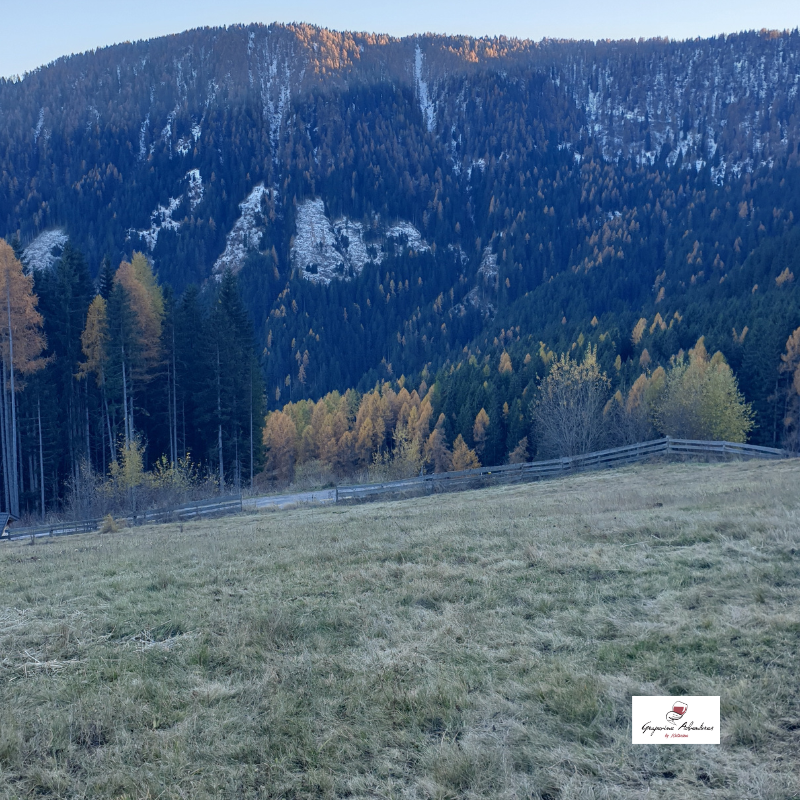
Let’s return to my previous discussion about how wine is connected to a place, its landscape, culture, history, and traditions.
In South Tyrol with the Dolomites, it gets very apparent; it stares you right in the face.
Concepts that came to mind while watching the film and tasting wines with Cantina Bolzano during the last days were
- Mountains
- Landscape (paesaggio)
- Art
- Community
- History
- Legacy
- …and, I would dare to say Heimat, the German word and concept that has probably been linked more to the German and Nordic countries through history. I am interpreting it loosely here, in the sense of reconnecting to a “home” —a place of origin, nostalgia —in a disassociated world. So, nothing political.
I have recently read articles about how younger people are feeling nostalgia and seeking meaning in a chaotic, uncertain world, one very much dominated by digital loneliness, algorithms, etc. See, for example, Abby Ho’s Substack publication, Fellow Kids.
They are looking for social connection and togetherness in smaller groups and communities, through shared experiences, analogue or offline. I am, of course, talking about this here as someone older looking from the outside.
Can nostalgia for places that feel like “home”, shared experiences and interests that feel familiar, and reconnecting with surrounding environments, nature, and off-screen help to reconnect also with wine. Wine is understood as part of a shared culture and history. Not only is wine an alcoholic beverage.
Landscape and environment do not need to be mountains or Alps; it can be the environment and shared experiences, as in the recent event Vin et Hip Hop, organised in Burgundy. It brought together hip-hop, love of wine, Brooklyn, and Burgundy.
I think there is a strong desire, in general, to reconnect as humans and be in the moment.
These are just thoughts and ramblings.
I will talk more about being “human”, AI, and how a winery can leverage its potential without losing its edge in a coming email.
Hey! You’ve reached the end of the preview of my newsletter. Subscribe to the WinesOfItaly Newsletter to get the full version of this newsletter.

